- A clean and secure energy future

The State of Renewable Energy in India 2019 – A Citizen’s Report
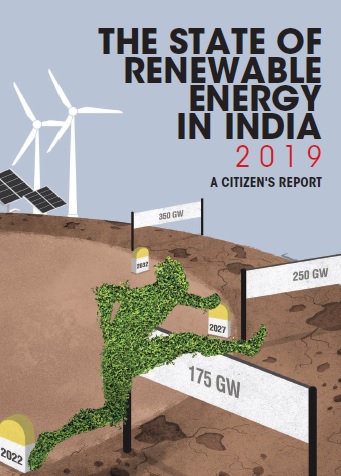
The State of Renewable Energy in India 2019 – A Citizen’s Report
Sector:Clean Power Undertaken By:Centre for Science and Environment Year Published:2019 Five years ago, when the first 'State of Renewable Energy' Report was published, the sector was just taking wings. Making a
timely intervention, the 2014 report offered several recommendations to encourage and nurture a sustainable growth for the sector. Some of these recommendations have found a place in the country’s policies.
Meanwhile, while years later, renewable capacity has reached 73 gigawatt (GW), accounting for over 20 per cent of the country’s total. Solar has performed particularly well: in 2017-18 alone, around 10 GW of solar was installed equaling the entire installed base. The capacity growth was driven by a sharp fall in tariffs, with both solar and wind auctions attracting bids that were lower than the cost of power from coal-based plants.
While 2017 left us with a sense of success, a lot still needs to be done to maintain the momentum. Indeed, 2018 has seen a reversal of some of the positive trends. Installations dropped to ~6.6 GW in the months between January to September. Tariffs went up as the government introduced a safeguard duty on imported PV modules. Solar auctions were cancelled or retendered for a lower size due to lack of developer interest and discoms’ demand for lower tariffs. Some of this slowdown is a temporary phenomenon, since longer term trends — such as declining PV module costs — remain in place. But there are also some policy and implementation hiccups that need to be addressed to ensure the sector continues to grow strongly.