
Energy in the form of electricity fuels economic growth. India has a 1.3 billion strong population. This coupled with an increased push for indigenous development means that India’s power demand is set to rise manifold over the coming decades. Projections forecast a rise in demand from approximately 949 terawatt-hours in 2015 to between 2074 terawatt-hours to 2785 terawatt-hours by 2030.
India’s demand for power comes from diverse sectors including industries, residential and commercial buildings, agriculture, rural and urban infrastructure, transport, among others. But it is important that the demand for electricity not be looked upon in isolation. The energy sector accounts for the highest carbon emissions in India. We must meet the rising demand with clean sources of power in order to promote energy security and climate stability.
The opportunity to meet India’s power demands with cleaner energy options has never been brighter. India’s target of achieving 175GW of renewable energy capacity by 2022 and 430GW by 2030, backed by policy and regulatory pushes, has put India among the top countries for its renewable energy efforts . The Saubhagya scheme has succeeded in connecting almost all Indian households to the electricity grid . The Indian government is committed to achieving the Nationally Determined Contributions as part of the Paris Climate Agreement as well as ensuring year-round energy access to all its citizens.
365 GW
Total installed power capacity in India
83GW
Total installed solar capacity in India
1096 GW
Total estimated potential for renewable power generation in India
The challenge today is to ensure that every person has access to clean and reliable power. This includes working with diverse stakeholders such as distribution utility companies, power generation companies, industrial and agricultural players, urban and rural consumers, and policymakers to ensure a clean and equitable power supply system for all.
Shakti Sustainable Energy Foundation’s work in the power sector supports the development of policies that help integrate a greater capacity of renewable energy in India’s power mix, enhance the state of play of the distribution sector, and ensure that all households in the country are provided with reliable electricity round the clock.

Sustained economic growth places an increased demand on energy resources, energy systems and infrastructure. Domestic energy demand is expected to double by 2040 with electricity…
Know more

Traditionally, electricity is generated through power sources and supplied to consumers via the power grid. Distribution utility companies, also known as discoms, supply this…
Know more
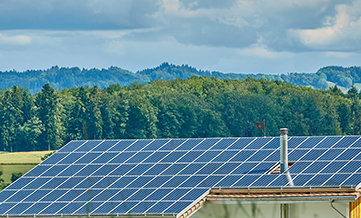
Access to reliable sources of energy is a central component of development. Raising the standard of living requires access to energy sources that can support and enhance the…
Know more
Search Our Work
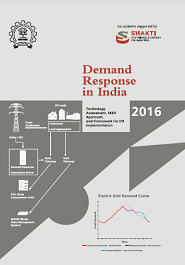
Resource Centre on Demand Side Management
Sector: Clean Power Undertaken By : IIT-Bombay Recent Publication: 2014Shakti has supported the creation of a technical resource hub on DSM at the Indian Institute of Technology, Bombay (IIT-B), dedicated to providing assistance to policymakers and other stakeholders on DSM-based interventions. In this capacity, IIT-B has been developing knowledge resources and conducting training programmes targeted at distribution...Read more
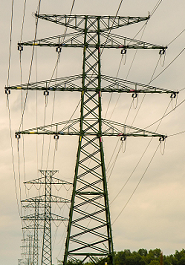
Implementing Demand Response Programmes
Sector: Clean Power Undertaken By : Multiple Recent Publication: 2014Demand response is a Demand Side Management measure that can help balance supply and demand by encouraging customers to curtail usage during times of high demand. Shakti is engaging with utilities and other stakeholders to develop best practices and models that promote Demand Response programmes across the country.
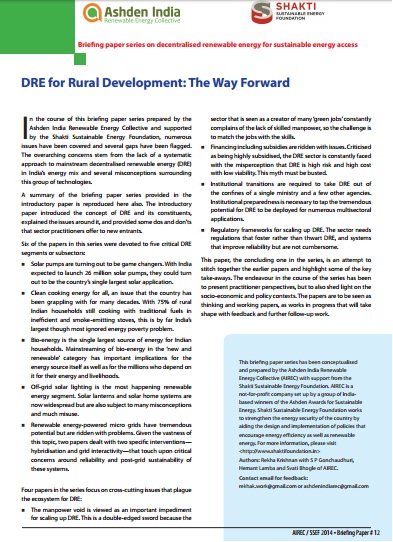
Briefing Paper Series on Sustainable Energy and Rural Energy Access
Sector: Clean Power Undertaken By : Ashden India Renewable Energy Collective Recent Publication: 2014Shakti has supported the development of a briefing paper series on decentralized renewable energy (DRE) that capitalizes on practitioner experience to inform new DRE interventions. Rural energy practitioners have systematically identified critical themes relevant to DRE in India. Each theme is presented in the form of a briefing paper. The papers...Read more
Reassessing Wind Potential Estimates for India
Sector: Clean Power Undertaken By : Multiple Recent Publication: 2013With the official estimate at 50 GW in 2011, India’s wind potential was viewed as quite limited. However, it was realized that this estimate did not take into account the availability of better technology, more advanced mapping techniques and a higher than previously thought land availability. A quick global comparison underscored this when our...Read more
Low-Cost Financing for Renewable Energy
Sector: Clean Power Undertaken By : CRISIL Risk and Infrastructure Solutions Limited Recent Publication: 2013Renewable energy is characterized by a relatively high initial investment, followed by low variable costs. Since a much greater share of the cost of energy is determined by the initial investment, higher financing costs have a disproportionate impact on renewable energy. This puts renewable energy at a relative disadvantage in India. Access to...Read more