
Climate change will have wide-ranging socio-economic impacts across demographics unless action is taken to mitigate it. Our current systems of economic development are largely carbon intensive, which result in a great deal of carbon emissions. Climate change is expected to have severe effects across sectors unless urgent action is taken to reduce greenhouse gas (GHG) emissions to 50 percent by 2050 from 1990 levels . Economic growth and climate change mitigation are not separate or antithetical to one another. Acting on climate mitigation strategies can result in positive economic benefits over a longer term.
While lowering emissions from carbon-intensive sectors is an important component of mitigating climate change, we must also focus on enhancing our developmental strategies to make economic growth inherently climate resilient. Such an approach will allow India to meet its climate targets while continuing an upward economic trajectory. The effort towards low-carbon development is closely tied to the tenets of the Paris Agreement that encourages economy-wide reduction and mitigation targets along with the development of market and non-market-based approaches to tackle climate change. The Paris Agreement also requires countries to track and regularly report their climate actions and GHG emissions as a means to evaluate progress on their NDC targets.
5% CAGR
Increase in India’s emissions from 1465 MtCO2e in 2005 to 2378 MtCO2e 2015
India’s NDC
is consistent with the 2oC goal of the Paris Agreement
1.6 tonnes of CO2
India’s per capita emissions today, well below the global average of 4.4 tonnes, while its share of global total CO2 emissions is approximately 6.4%.
Shakti Sustainable Energy Foundation is supporting efforts to develop and implement integrated climate strategies, establish linkages between climate action and socio-economic impacts and deepen engagements among stakeholders. We are helping to advance national and state level efforts to better understand the implications of global commitments on India’s development paradigm. We are also supporting efforts to build adequate capacities amongst various stakeholders to manage greenhouse gas emissions.
Search Our Work
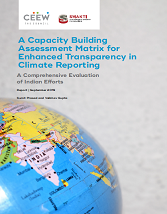
Assessing Capacity-Building Needs for India’s Climate Actions
Sector: Climate Policy Undertaken By : Council on Energy, Environment and Water Recent Publication: 2019For India to be a part of a global governance structure that effectively responds to the threat of climate change, it is essential to have consensus among key domestic stakeholders on the need for India to develop a low-carbon economy. This requires identifying opportunities that demonstrate the advantages of pursuing low-carbon growth pathways in...Read more

Market Mechanisms for GHG Abatement
Sector: Climate Policy Undertaken By : Multiple Recent Publication: 2019India will need to rely upon market-based mechanisms such as internal carbon pricing, carbon taxes, the emissions cap and trade to manage GHG emissions. Shakti is facilitating research and stakeholder consultations to facilitate the emergence of suitable market-based instruments.
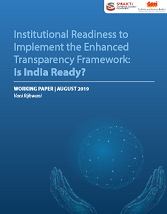
Interpreting the Transparency Framework under the Paris Agreement and its Implications for India
Sector: Climate Policy Undertaken By : The Energy and Resource Institute Recent Publication: 2019The transparency framework is an important element of the Paris Agreement. It includes obligations for countries to evaluate their mitigation efforts. But what are the implications of this framework for India? As key parameters of the transparency regime are negotiated and agreed upon, India will have to strengthen its domestic institutional...Read more

Sikkim Gets a GHG Inventory and MRV System
Sector: Climate Policy Undertaken By : IORA Ecological Solutions Pvt. Ltd Recent Publication: 2019Shakti is facilitating the development of The Sikkim Climate Inventory and Monitoring System (SCIMS), which emanates from the state’s vision to remain carbon neutral. The SCIMS is the first step for Sikkim towards realizing the vision of being carbon neutral. The SCIMS is an automated system that annually inventorises GHG emissions by sources...Read more
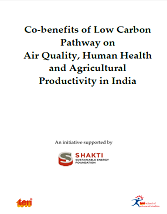
Climate Co-benefits
Sector: Climate Policy Undertaken By : The Energy and Resource Institute Recent Publication: 2018The consideration of climate co-benefits such as reduced health effects and improved agricultural yields, among others, should inform policy decisions on climate change. Shakti is enabling both qualitative and quantitative research to characterize co-benefits that will be derived through policy actions designed to mitigate climate change.