
Businesses are crucial stakeholders in the fight against climate change. Over a quarter of India’s emissions are directly caused by the business operations of the commercial and industrial sectors. As per India’s Second Biennial Update Report, Energy and Industrial Processes and Product Use (IPPU) sectors in India accounted for 8% of GHG emissions while 18.4% of the emissions from the energy sector can be attributed to manufacturing industries and the construction sector. Commercial & Industrial customers also consume more than 50% of electricity in India. India’s national emissions can fall by as much as 1.5% merely through the voluntary emission mitigation measures taken by 50 Indian businesses.
50%
Companies transitioning towards 100% renewable energy are experiencing cost savings already
94%
Surveyed Indian CEOs believe that sustainability is key to long-term business success
10%
Predicted climate-caused reduction in India’s economy by the end of the century
Businesses are also extremely vulnerable to the impact of climate related disasters, from the physical risks posed by extreme weather and shifting climate patterns to the transition risks resulting from public support for the transition to a low carbon economy. Thus, it is critical for businesses to adopt practices that are geared towards the mitigation of climate change impacts. Lowering the carbon footprint of the value chain and improving industrial processes towards more sustainable models can help the country meet its climate targets and help businesses become more climate resilient. Demonstrating awareness of this impending risk, Indian corporates are increasingly aligning themselves with internationally recognised reporting and disclosure frameworks such as the Global Reporting Initiative (GRI), Science Based Targets Initiative (SBTi), and recommendations of the Task Force on Climate-related Financial Disclosures (TCFD).
Innovative new financial institutions and business models can encourage both demand generation and supply versatility of clean energy finance. In addition, facilities which endorse the viability of early stage businesses and business models can catalyze increased finance for the clean energy landscape. Shakti Sustainable Energy Foundation seeks to facilitate the development of business models and avenues that can drive the clean energy sector as well accelerate the transition to a low-carbon economy.
Search Our Work
Showing 1 to 7 of 7 entries

Climate Risk Pricing Approaches for Investment Portfolios in India
Sector: Clean Energy Finance Undertaken By : Intellecap Advisory Services Pvt. Ltd. Recent Publication: 2020Given India’s extremely high sensitivity to climate-risk , it is important to develop advanced frameworks for our local context that can assist in climate risk identification and quantification for investment portfolios and suggest options for appropriate climate risk mitigation. Doing so requires an understanding of the current level of...Read more

Financing Needs of Nascent Clean Energy Technology Businesses
Sector: Clean Energy Finance Undertaken By : Multiple Recent Publication: 2019There is a need to encourage, support, and scale innovation in order to advance to a more sustainable, nimble, and secure energy future. Emerging technologies have a business life cycle: research and development (R&D), demonstration, and eventual commercialisation. Clean energy projects, especially those in their nascent stages, have long...Read more

New and Innovative Sources of Finance for Renewable Energy
Sector: Clean Energy Finance Undertaken By : Climate Policy Initiative Recent Publication: 2018India is pursuing an ambitious goal — significantly expanding the share of renewable sources in its energy supply mix. There is a widespread recognition that financing for renewable energy must be scaled up significantly from its current levels. Going forward, India will have to efficiently and effectively mobilise further financial resources...Read more

Catalyzing Investments for Sustainable Urban Transport through Municipal Finance Reforms
Sector: Clean Energy Finance Undertaken By : Janaagraha Centre for Citizenship and Democracy Recent Publication: 2017Over the next 20 years, India’s cities will require an investment of at least USD 800 billion to meet the growing demand for civic services. While some of this can be met through government funding, increasingly cities will have to seek recourse through other means, including the issuance of municipal bonds. While the potential of India’s...Read more

Public Finance For Climate Action
Sector: Clean Energy Finance Undertaken By : Institute of Financial Management and Research Recent Publication: 2017India's climate finance requirements are enormous. Public finance can play a catalytic role in combating climate change and in meeting the target set under India's Nationally Determined Contributions. When combined with private financing and international climate finance, public finance can push climate change related mitigation and adaptation...Read more

Improving Finance for Clean Energy Access in India
Sector: Clean Energy Finance Undertaken By : Intellecap Advisory Services Pvt. Ltd. Recent Publication: 2017Decentralized Renewable Energy (DRE) enterprises have immense potential to meet India's energy needs, particularly in rural areas. Shakti facilitated the development of a multi-approach programme to enhance access to finance for DRE enterprises by : providing technical assistance services to DRE enterprises and financial institutions, designing...Read more
- Alternate Financing Facilities
- Alternate Financing Facility for Energy Access in India
- Framework for the Monitoring and Evaluation of DRE enterprises
- Decentralized Renewable Energy Evaluation and Monitoring Tool (DREEM) tool
- Monitoring and Evaluation Framework For Off-Grid Enterprises in India – DREEM Tool
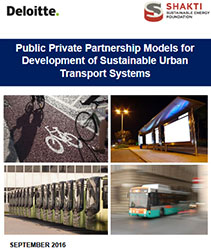
Financing Sustainable Urban Transport through Public-Private Partnerships (PPPs)
Sector: Clean Energy Finance Undertaken By : Deloitte Touche Tohmatsu Limited Recent Publication: 2016The Smart Cities Mission will require significant amounts of capital to meet the rapidly growing requirements of cites. One way for cities to generate additional funds is Public-Private Partnerships (PPPs). The Smart Cities Mission has placed significant emphasis on the PPP model encouraging the private sector to mobilize capital, technology and...Read more
Showing 1 to 7 of 7 entries