
Traditionally, electricity is generated through power sources and supplied to consumers via the power grid. Distribution utility companies, also known as discoms, supply this energy to consumers at fixed rates. India has a large capacity for power generation with generation increasing at a CAGR of 8.9% from 124GW to 344GW between 2006 and 2018.
Distribution companies in India face myriad challenges and as a result, the electricity distribution sub-sector is often considered to be the weakest link in the overall power sector value chain. But the distribution sector has seen significant improvements in the last few years. overall peak and energy demand deficits have significantly reduced; there has been a gradual decrease in AT&C losses, i.e., losses from technical and commercial inefficiencies; and tariff revisions that have led to a reduction in the gap between the average cost of supply and average revenue realized, among others .
With clean technologies growing in importance, distribution companies are also being expected to take on additional responsibilities like providing electric vehicle infrastructure, incorporating more renewable energy into the grid, and helping the government accelerate the growth of the solar rooftop sector among other concerns. These responsibilities come with additional technical and operational challenges. Open access, which enables eligible consumers to procure power at competitive price to meet their demand, from suppliers other than the distribution companies is another critical concern that distribution companies in India are contending with.
Many reforms have been introduced by the government to improve the health of distribution utilities. The Ujwal DISCOM Assurance Yojana (UDAY) is a flagship scheme by the government of India that envisages financial turnaround, operational improvement, reduction of cost of generation of power, development of renewable energy and energy efficiency and conservation for a strong distribution sector . Smart metering and digitalisation of processes are also being pushed in order to improve the financial and operational viability of distribution companies. However, more remains to be accomplished in order to ensure optimal discom health, which in turn can lead to an improved electricity supply system for India.
360+ GW
Total installed power capacity in India
73
Distribution Utilities in India
1,372 TWh
Electricity generated by utilities in 2018-19
Shakti Sustainable Energy Foundation works with several stakeholders across the country including Central Government entities, state level stakeholders and utilities to strengthen demand side management (DSM) and facilitate distribution sector reforms.
Search Our Work
Making India's Electricity Sector More Sustainable - Tariff Reforms, Industry Involvement and Innovative Business Models
Sector: Clean Power Undertaken By : Multiple Recent Publication: 2021India is seeking to transform its power sector in a way to promote access, reliability, affordability and sustainability. Several important policies have been announced in this regard, but there are still concerns around high AT&C losses, low quality of service, peak power deficits and high cross-subsidies. In particular, electricity tariff...Read more
Propelling India's electricity transmission sector
Sector: Clean Power Undertaken By : Idam Infrastructure Advisory Services Pvt. Ltd., Prayas (Initiatives in Health, Energy, Learning and Parenthood) Recent Publication: 2021The power sector in India is undergoing radical transformation. India has embarked upon ambitious renewable energy targets with several initiatives ( utility scale solar, wind farm projects, solar parks, hybrid RE projects with storage and rooftop solar) underway at the national and state levels. A strong and robust transmission system is key to...Read more
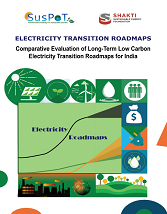
Comparative Evaluation of Long-Term Low Carbon Electricity Transition Roadmaps for India
Sector: Clean Power Undertaken By : Center for Sustainability, Policy & Technology Management (SusPoT) Recent Publication: 2020Developing and evaluating various low carbon electricity transition scenarios can be a powerful way to analyze the role of the power sector in climate mitigation. Long-term scenarios are required for an effective energy transition since they are informed by transparent, fact-based, country-specific parameters that address interdependencies of the...Read more

The Distribution Utilities Forum
Sector: Clean Power Undertaken By : The Energy and Resource Institute Recent Publication: 2021India has set the important goals ensuring financial sustainability of the distribution sector, providing 24X7 affordable power supply, realizing a greater share of cleaner resources and achieving universal household electrification by March 2019. Distribution Utilities will play a key role in helping India meet these goals. The Distribution...Read more
Advancing Power Sector Reforms in Maharashtra
Sector: Clean Power Undertaken By : World Institute of Sustainable Energy Recent Publication: 2020The power sector in India is transitioning rapidly, and stakeholders are continuously attempting to minimize revenue losses, improve quality of supply, meet emerging customer expectations, and achieve better environmental performance. To achieve these goals, it is necessary to facilitate the implementation of new policies and frameworks to make...Read more